

Trump administration cannot hold migrants without bond hearings past 90 days, court rules
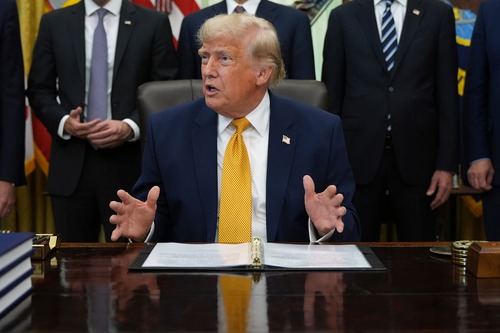 A different panel of the same court had been the first in the nation to endorse the Trump
administration’s novel interpretation of a federal immigration
statute as allowing mandatory detention of non-citizens in the US. File
A different panel of the same court had been the first in the nation to endorse the Trump
administration’s novel interpretation of a federal immigration
statute as allowing mandatory detention of non-citizens in the US. File
- Trump administration asks US Supreme Court to overturn ruling rejecting its no-bond detention policy
- Hundreds of judges have ruled against Trump administration's interpretation of law
- Federal appeals courts are divided on the issue
June 26 (Reuters) - U.S. President Donald Trump's administration has asked the U.S. Supreme Court to let it detain people arrested in its immigration crackdown without a chance to seek bond, even if they have lived in the country for years.
The administration made that request in a filing, opens new tab made public on Friday, asking the Supreme Court to overturn a May decision by a federal appeals court, which had rejected its reinterpretation of a decades-old immigration law that now underlies its mass detention policy.
Detaining aliens who are living in the country after an illegal entry while their removal proceedings unfold prevents those aliens from evading hearings and helps ensure their removal from the United States," Sauer argued in a petition. Bucking a long-standing interpretation of immigration law, the U.S. Department of Homeland Security last year took the position that non-citizens already residing in the United States, and not just people arriving at the border, qualify as "applicants for admission" subject to mandatory detention.
Under federal immigration law, "applicants for admission" to the United States are subject to mandatory detention while their cases proceed in immigration courts and are ineligible for bond hearings. The Board of Immigration Appeals, which is part of the Justice Department, issued a decision in September that adopted that interpretation. As a result, immigration judges, who are employed by the department, across the country began ordering mandatory detention.
The 6th Circuit's ruling came in cases out of Michigan involving citizens of Mexico, El Salvador, Venezuela, Nicaragua and Guatemala who had resided in the United States for years before being arrested by U.S. Immigration and Customs Enforcement or U.S. Customs and Border Protection. It held that the administration misinterpreted a provision of the Illegal Immigration Reform and Immigrant Responsibility Act of 1996 and that the migrants were denied bond hearings in violation of their due process rights under the U.S. Constitution's Fifth Amendment.