

Boston’s budget season is over, but bruises still show.
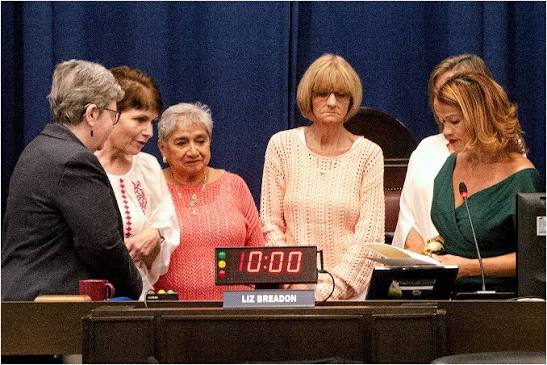 Above: BPS paraprofessionals at a June 3 council meeting, flanked by City
Council President Liz Breadon, left, and Councillor Julia Mejia, right .
Above: BPS paraprofessionals at a June 3 council meeting, flanked by City
Council President Liz Breadon, left, and Councillor Julia Mejia, right .
To disentangle weeks of anguished complexity over the city budget for FY27, all it took was Boston’s outbreak of World Cup Soccer fever. As District 7 (Roxbury) City Councillor Miniard Culpepper reminded his colleagues at a meeting on June 24, Boston’s prowess in pubs and beer had just been sorely tested by a bibulous influx of Scottish soccer fans, upsetting the familiar balance between supply and demand. “When bars run out of beer. I mean, it’s not funny,” Culpepper mused. “I think it’s really sad that we are cutting paraprofessionals and teachers. Bars are running out of beer. The conversation about how we responsibly grow and diversify city revenue in a changing fiscal environment must begin now.”
At the same meeting, the council punctuated the conversation with the procedural stop of a motionless action. After five years of being equipped with additional budget powers granted by voters, the body could only manage limited changes, amid higher expectations for its clout and diminished forecasts for growth in tax revenue. In the 2021 city election, voters approved a charter amendment that allowed the council to change budgets filed by the mayor, but without an increase in total spending. Any added spending had to be equaled by subtractions or “pulls” from other items. Previously, the council could only act on the budget in bulk, by approving without new spending, or rejecting—in the hope that the mayor would send it back with revisions. Five years ago, Boston’s tax base was still surging, despite the pandemic, thanks to work in progress on new housing and commercial space. In FY26, which ended on June 30, the city reported that growth in tax revenue from new development had dropped from the previous year by one-third. For the first time in at least nine years, the new revenue figure was lower than the standard 2.5 percent annual levy increase.
Not foreseen when the charter change was advocated by the Better Budget Alliance (BBA) was how the growth would shrink, as well as how the mayor and the council would face increasing pressure to avoid spending cuts. Even less apparent was how councillors pinpointing budget “pulls” would get information from mayors whose spending plans might be contested. At the council meeting on May 20, the previous chair of the Ways & Means Committee, District 4 (Dorchester/Mattapan) Councillor Brian Worrell, led an effort to reject the budget filed by the mayor in April. Worrell argued that the move could result in more concessions by the mayor’s administration, possibly based on more generous revenue projections. But Worrell’s motion gained only six votes, one less than needed for passage, and a near copy of the contentious vote for council presidency in January. The current Ways & Means chair, District 6 (West Roxbury/Jamaica Plain) Councillor Ben Weber, maintained in a June 29 interview that, even after May 20, some of his colleagues wanted spending changes that would make rejection more likely. “Whereas, in prior years, I thought we were all working together to try to make the package as good as possible,” he said, “this time, it did seem like, even after our rejection vote, that some people were trying to eliminate sources of funding or make it so impossible to work, so that rejection would be our only way forward.”
Weber tried to have a vote on the budget with amendments by his committee on June 3, but the move was tabled. At a working session two days earlier, additional changes had been suggested by the committee’s vice chair, District 3 (Dorchester) Councillor John FitzGerald. At the council meeting on June 10, his package of amendments—incorporating changes sought by some councillors who had previously voted for rejection–was merged with the package further revised under Weber. Weber says that “almost all” of what the council approved on June 10 was in his original package, but he acknowledged the difference between a near-deadlock on May 20 and approval three weeks later by a numerically veto-proof count of 12-1. “It did seem like it made a difference,” he said. “Any way we could come together, that’s how we’re going to accomplish more as a body, so I was for it.” A week later, Mayor Michelle Wu sent the council a letter agreeing with almost all of the changes approved on June 10. Not as lengthy as the culminating budget action two years ago, this year’s decisive meeting was marked by a two-hour disruption that temporarily converted the give-and-take of procedure in the council chamber into a non-violent show of force, staged by protesters and uniformed security.
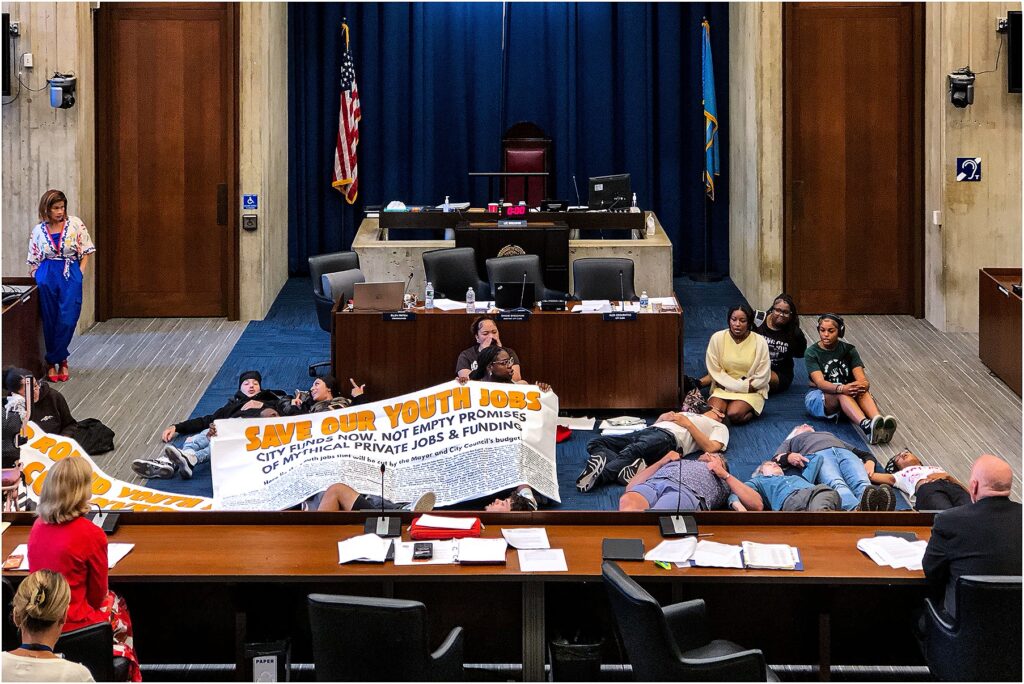
Nine days after the meeting, former city councillor Larry DiCara said that his successors had been bullied—a view they did not express publicly. But, even after the protest, its most visible ally in the chamber, Councillor-At-Large Julia Mejia, insisted that the body could have done more to offset budget cuts, a view seconded later, near the end of the meeting, by Worrell. “Time and time again,” said Worrell, “we hear the same message: ‘There’s no money, it’s going to get worse, do not ask for more, do not expect more, and don’t even imagine more.’ But, in one of the wealthiest cities in the country, with a $4.9 billion budget, nearly $2 billion in reserves, and a track record of collecting more than $200 million above projected revenue, I have to ask, who says there’s no money?” The council’s amendments, as summarized by Weber on June 24, totaled $11.52 million, or slightly more than 0.2 percent of the $4.9 billion operating budget. At an earlier stage, he hailed the amount for being greater than similar amendments pushed by the council in recent years. On June 24, the council ended up following Weber’s recommendation of non-action, which allowed the changes on June 10 to take effect, along with the mayor’s one alteration.
“This budget restores cuts, maybe not at the level I would have liked to see them,” Culpepper said at the meeting, “but it does restore cuts that never should have been cut in the first place.” Other councillors expressed frustration about cuts that were not reversed, especially in the Boston Public Schools (BPS) budget, and difficulties with getting accurate and up-to-date information on spending. One difficulty factored in a $1.4 million “pull” from “personnel services” in the Boston Transportation Dept. (BTD) that was advanced by FitzGerald only to be flagged by the mayor’s administration as potentially causing layoffs and reducing services. As detailed by her letter, Wu only transposed the same “pull” amount to BTD’s contractual services. It was a small difference, but enough to put some councillors on the spot.